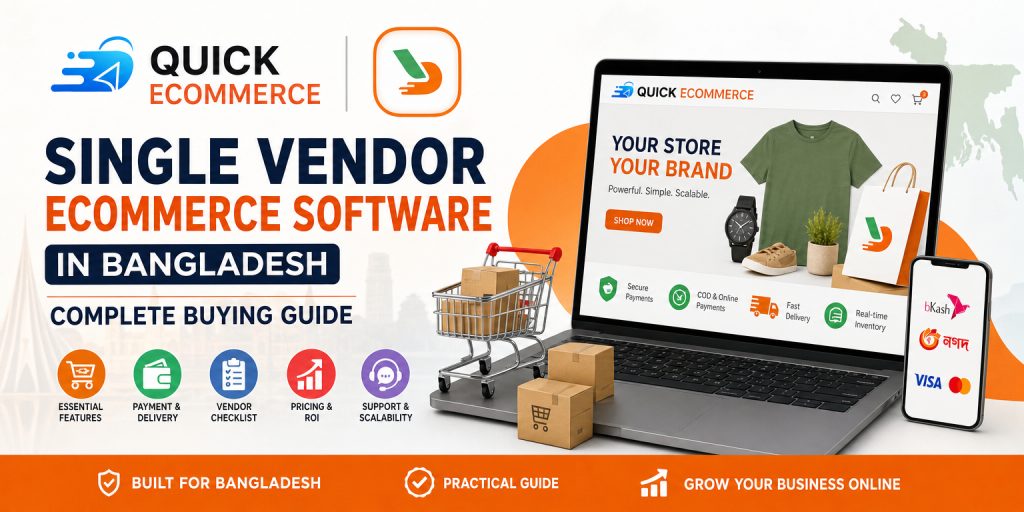
Single Vendor Ecommerce Software in Bangladesh: Complete Buying Guide
Introduction
Single vendor ecommerce software in Bangladesh is a system that lets one business – a brand, retailer, manufacturer, or wholesaler – sell its own products through a dedicated online store, with one admin panel controlling products, inventory, orders, payments, and customers.
If you sell only your own products (not a platform where multiple sellers list their own items), this is the category of software you need – not a marketplace system.
This guide is built for business owners in Bangladesh who are trying to answer a very practical question: what software do I actually need, what should it cost, and how do I avoid buying the wrong thing? We’ll cover how the software works, which features matter, what makes a platform Bangladesh-ready (COD, bKash, Nagad, courier integration, Bangla language support), how pricing models work, and a step-by-step framework for choosing and evaluating vendors.
We will not recommend a single “best” product. Instead, this guide gives you the criteria, questions, and frameworks to make that decision yourself – or to brief a developer or vendor with confidence.
What Is Single Vendor Ecommerce Software?
In short: Single vendor ecommerce software is a platform that allows one business to manage its own online store – products, stock, orders, customers, and payments – from a single admin dashboard. Unlike a marketplace, there is only one seller, and that seller controls the entire storefront.
How it works
The software typically has two connected parts:
- Storefront (customer-facing): where customers browse products, add items to cart, and check out.
- Admin panel (business-facing): where the business owner or staff manage products, track orders, update inventory, and view reports.
Core components
- Product catalog and categories
- Inventory tracking
- Shopping cart and checkout
- Payment processing
- Order management
- Customer records
- Basic reporting
Who controls the store
One business owns the entire store – branding, pricing, product listings, customer relationships, and fulfillment. There’s no commission-sharing with other sellers because there are no other sellers.
Difference from a marketplace
A marketplace (multi-vendor platform) hosts many independent sellers under one website, each managing their own listings, with the platform typically taking a commission on sales. A single-vendor system has exactly one seller: you.
How Does a Single Vendor Ecommerce System Work?
Understanding the order lifecycle helps clarify what the software actually needs to do well.
- Customer visits the website or app
- Browses products – by category, search, or filter
- Adds products to cart
- Checkout – enters delivery details and selects a payment method
- Payment – via bKash, Nagad, card, bank, or cash on delivery
- Order processing – the admin panel receives and confirms the order
- Inventory update – stock is automatically reduced
- Delivery – the order is handed to a courier or in-house delivery team
- Customer receives the order
- Reporting and follow-up – sales data, accounting entries, and customer history are updated
The role of each system component
| Component | Role |
| Admin panel | Central control for products, orders, users, and settings |
| Product catalog | Stores product details, variants, pricing, and images |
| Inventory | Tracks stock levels across warehouses or locations |
| Order management | Tracks order status from placement to delivery |
| Customer management | Stores customer profiles and order history |
| Payment gateway | Processes online payments securely |
| Delivery integration | Connects with courier services for shipping and tracking |
| Reporting | Shows sales, stock, and customer trends |
| Notifications | Alerts customers and staff about order status changes |
Who Should Use Single Vendor Ecommerce Software in Bangladesh?
This model fits businesses that sell their own products and want full control over branding, pricing, and customer experience.
Good fit:
- Fashion and apparel brands
- Furniture businesses
- Electronics retailers
- Grocery and daily essentials businesses
- Cosmetics and beauty brands
- Lifestyle and home goods brands
- Manufacturers selling direct to consumers (D2C)
- Wholesalers expanding into B2C
- Local retailers digitizing their shop
- Home appliance sellers
- Food and packaged product brands
- SMEs replacing manual, Facebook-only order taking
When it may NOT be the right fit:
- You want to host multiple independent sellers under one platform (you need a marketplace/multi-vendor system instead)
- You only sell a handful of products occasionally and social media selling is sufficient for now
- You have no operational capacity to fulfill online orders reliably yet – in that case, fixing operations may come before buying software
Single Vendor vs Multi Vendor Ecommerce Software
This is one of the most important distinctions to understand before buying.
| Factor | Single Vendor | Multi Vendor |
| Sellers | One business | Multiple independent sellers |
| Inventory ownership | Owned by the single business | Owned by each individual seller |
| Product management | Centralized, by one team | Decentralized, by each seller |
| Order management | One fulfillment process | Multiple sellers fulfill their own orders |
| Commission | Not applicable | Platform usually earns commission per sale |
| Customer relationship | Owned entirely by the business | Often shared or mediated by the platform |
| Payment flow | Direct to the business | Often split between platform and sellers |
| Administration | Simpler, single control point | More complex, seller onboarding and payouts needed |
| Complexity | Lower | Higher |
| Cost | Generally lower to build and maintain | Generally higher due to added seller management logic |
| Best use case | A brand or retailer selling its own catalog | A platform connecting many sellers to buyers |
Why Businesses in Bangladesh Need Ecommerce Software
Many small and mid-sized businesses in Bangladesh currently run online sales manually – through Facebook Pages, WhatsApp, or phone orders – without dedicated software. This works at small scale but creates real friction as order volume grows:
- Facebook-based selling limitations: no built-in inventory tracking, order status system, or centralized customer records
- Manual order processing: orders tracked in notebooks or spreadsheets, prone to errors
- Inventory problems: overselling out-of-stock items, no real-time visibility
- COD management: difficulty reconciling cash-on-delivery payments against actual orders
- Payment reconciliation: manually matching bKash/Nagad transactions to orders
- Delivery coordination: manually communicating with courier services for each order
- Customer data management: no structured record of repeat customers or order history
- Product/catalog management: difficulty maintaining consistent pricing and descriptions across channels
- Sales reporting: no easy way to see what’s actually selling
- Multiple sales channels: managing Facebook, website, and phone orders separately
- Business scalability: manual processes that worked for 10 orders a day break down at 100+
Dedicated ecommerce software addresses these operational gaps directly, rather than adding more manual work.
Essential Features of Single Vendor Ecommerce Software
For each feature below: what it does, why it matters, and what to check before buying.
Product Management
What it does: Lets you create products with categories, variations (size, color), SKUs, pricing, discounts, images, and attributes, and control whether a product is published or hidden.
Why it matters: Your catalog is the foundation of the store. Poor product management leads to inconsistent pricing and confusing listings.
Check before buying: Can you bulk-upload products via spreadsheet? Does it support product variants without creating duplicate listings?
Inventory Management
What it does: Tracks real-time stock, allows manual stock adjustment, sends low-stock alerts, supports multiple warehouses, keeps stock history, and synchronizes inventory across channels.
Why it matters: Prevents overselling and stockouts, which directly damage customer trust.
Check before buying: Does stock update automatically when an order is placed or cancelled? Can you manage stock across more than one warehouse or store location?
Order Management
What it does: Handles order processing, status updates, cancellations, returns, refunds, and partial fulfillment.
Why it matters: A clear order pipeline reduces missed or delayed orders, which is one of the most common customer complaints in Bangladeshi ecommerce.
Check before buying: Can order statuses be customized to match your fulfillment process? Is partial order fulfillment supported?
Customer Management
What it does: Stores customer profiles, order history, allows segmentation, and supports customer communication (SMS/email/notifications).
Why it matters: Repeat customers are usually more profitable than one-time buyers; you need visibility into who they are.
Check before buying: Can you export customer data? Can you segment customers by order value or frequency?
Shopping Cart & Checkout
What it does: Lets customers add products, apply discounts, and complete purchases with minimal friction.
Why it matters: A confusing or slow checkout is one of the biggest causes of abandoned carts.
Check before buying: Is guest checkout supported (no forced account creation)? Is the checkout mobile-friendly?
Payment Gateway Integration
What it does: Processes payments through supported methods. Commonly used payment methods in the Bangladesh market include bKash, Nagad, debit/credit cards, internet banking, and cash on delivery – but do not assume any specific software supports these unless the vendor confirms and demonstrates the integration.
Why it matters: In Bangladesh, customer payment preferences vary widely, and limited payment options can lose sales.
Check before buying: Which specific gateways are pre-integrated versus requiring custom development? Are transaction fees clearly disclosed?
Delivery & Courier Integration
What it does: Connects the store to courier services for shipment booking, tracking, and delivery status updates.
Why it matters: Manual courier coordination for every order doesn’t scale. Integration saves time and reduces delivery errors.
Check before buying: Which courier services does the vendor actually support today, not just in future roadmap plans?
Discount & Coupon Management
What it does: Allows time-bound discounts, coupon codes, and promotional pricing.
Why it matters: Supports marketing campaigns without manual price editing.
Check before buying: Can discounts be limited to specific products, categories, or customer segments?
Sales & Revenue Reporting
What it does: Shows sales trends, best-selling products, and revenue over time.
Why it matters: Without reporting, decisions are based on guesswork rather than data.
Check before buying: Can reports be exported? Are reports available by date range, product, or category?
Mobile Responsive Store
What it does: Ensures the storefront works well on smartphones.
Why it matters: A majority of ecommerce browsing and buying in Bangladesh happens on mobile devices, making this non-negotiable.
Check before buying: Test the actual checkout flow on a mobile browser before purchasing, not just the homepage.
SEO Features
What it does: Supports SEO-friendly URLs, meta tags, and structured content (detailed further below).
Why it matters: Organic search traffic is a low-cost, long-term acquisition channel.
Check before buying: Can you edit meta titles and URLs per product and category without developer help?
Security
What it does: Protects customer data and payment information through encryption, secure login, and access controls.
Why it matters: A data breach damages trust and can create legal exposure.
Check before buying: Does the platform support SSL by default? How are admin access permissions controlled?
User & Role Management
What it does: Allows multiple staff accounts with different permission levels.
Why it matters: Prevents unauthorized changes and supports team-based operations as you grow.
Check before buying: Can you restrict staff to specific modules (e.g., order processing only, no pricing access)?
Notifications
What it does: Sends automated alerts to customers and staff for order confirmations, status changes, and delivery updates.
Why it matters: Reduces customer service inquiries and keeps customers informed.
Check before buying: Are notifications sent via SMS, email, or both? Is SMS gateway cost included or separate?
CMS / Content Management
What it does: Lets you edit pages like About Us, Policies, and blog content without developer involvement.
Why it matters: Keeps the store’s informational content current and supports SEO.
Check before buying: Can non-technical staff edit content directly?
Analytics
What it does: Tracks visitor behavior, conversion rates, and traffic sources.
Why it matters: Helps identify where customers drop off in the buying journey.
Check before buying: Does it integrate with tools like Google Analytics or Meta Pixel?
Accounting / ERP Integration
What it does: Connects sales data with accounting or enterprise resource planning systems.
Why it matters: Reduces double data entry and manual reconciliation as the business scales.
Check before buying: Is this integration available out-of-the-box or does it require custom development?
POS Integration
What it does: Connects online sales with in-store point-of-sale systems for unified inventory and reporting.
Why it matters: Important for businesses selling both online and through physical stores.
Check before buying: Does inventory sync in real time between POS and the online store, or with a delay?
Social Commerce Integration
What it does: Connects the store with Facebook and Instagram catalogs.
Why it matters: Many Bangladeshi customers still discover products through social media even if they purchase via the website.
Check before buying: Does the vendor support this natively, or would it require a third-party tool?
Bangladesh-Specific Features to Look For
A platform built generically for global markets may miss important local realities. Look specifically for:
- BDT currency support as the default, not an afterthought
- Cash on Delivery (COD) as a fully supported payment method, with reconciliation tools
- Local payment gateways such as bKash and Nagad, confirmed and demonstrated, not just claimed
- Local courier integration with services operating in Bangladesh
- Bangla language support for the storefront, at minimum, and ideally the admin panel
- English language support alongside Bangla, since many businesses operate bilingually
- Local invoice formatting matching business norms
- Customer phone-number-based ordering, since many customers order via phone rather than only web forms
- Delivery charge rules by location (e.g., inside Dhaka vs. outside Dhaka)
- District/upazila-level delivery zone configuration
- COD reconciliation tools to match cash collected against orders
- Mobile-first design, given the dominance of mobile browsing
- Local customer support in Bangla and English, with realistic response times
- Hosting considerations, including server location and latency for local users where relevant
A note on VAT and tax: ecommerce software may support basic VAT-inclusive pricing and invoice fields, but this guide does not provide tax or legal advice. Confirm VAT and NBR-related compliance requirements with a qualified accountant or the National Board of Revenue directly.
How Much Does Single Vendor Ecommerce Software Cost in Bangladesh?
There is no single “average price” that applies to every business – costs depend heavily on scope. Instead of quoting a market average, here’s how to evaluate what you’re being quoted.
Common pricing models
- SaaS subscription – monthly or annual fee, typically includes hosting, updates, and basic support
- One-time license – a fixed payment for the software, with hosting and maintenance handled separately
- Custom development – built from scratch or heavily customized, priced by project scope
- Hybrid model – a base platform with paid add-ons or custom modules
Cost factors to evaluate
- Number of products and categories
- Number of admin/staff users
- Custom design vs. template-based design
- Mobile app (in addition to website)
- Number and type of payment integrations
- Number of courier integrations
- ERP/POS/accounting integration
- Hosting and server requirements
- Security features (SSL, backups, monitoring)
- Ongoing maintenance and updates
- Support level (email-only vs. phone/priority support)
- Data migration from an existing platform
Illustrative cost-comparison framework
The figures below are illustrative categories only, not actual price quotes. Always request a detailed, itemized quote from vendors.
| Setup Tier | Typical Scope | What to Expect |
| Basic setup | Small catalog, template design, standard payment/COD, single warehouse | Lower upfront cost, faster launch, limited customization |
| Growing business setup | Larger catalog, some custom design, multiple payment/courier integrations, basic reporting | Moderate cost, more configuration time |
| Advanced/custom setup | Large catalog, custom features, ERP/POS integration, multiple warehouses, dedicated support | Higher cost, longer implementation, greater long-term flexibility |
When comparing quotes, always ask what is included versus billed separately (hosting, SMS gateway fees, payment gateway fees, ongoing support, future customization).
Ready-Made Ecommerce Software vs Custom Ecommerce Development
| Factor | Ready-Made Software | Custom Development |
| Initial cost | Lower | Higher |
| Development time | Faster (days to weeks) | Slower (weeks to months) |
| Customization | Limited to platform capabilities | Fully tailored to business needs |
| Scalability | Depends on platform’s architecture | Can be designed for specific scale requirements |
| Maintenance | Often handled by vendor | Requires ongoing development resources |
| Security | Managed by vendor, varies by provider | Depends on the development team’s practices |
| Ownership | May be licensed, not fully owned | Typically fully owned by the business |
| Support | Vendor-provided, varies in quality | Depends on contract terms |
| Integrations | Pre-built, limited set | Can be built to match exact requirements |
| Upgrade process | Managed by vendor | Requires dedicated development effort |
Which option fits which business:
- Startups and early-stage SMEs: Ready-made software is usually more practical – faster to launch, lower upfront cost, and sufficient for validating the business model.
- Established SMEs with specific workflows: A hybrid approach (ready-made platform with custom modules) often balances cost and flexibility.
- Large enterprises with complex operations: Custom development may be justified when integration needs (ERP, multiple warehouses, unique workflows) exceed what ready-made platforms support.
Ecommerce Software vs Website Builder vs Marketplace
| Category | Best For | Key Limitation |
| Ecommerce software | Businesses needing full store management (inventory, orders, customers) | Requires setup and configuration |
| Website builder | Very simple stores, limited product ranges | Limited scalability and advanced features |
| Marketplace (join an existing one) | Sellers wanting quick access to existing buyer traffic | Less control over branding, commission fees, less direct customer relationship |
| Custom ecommerce system | Complex, specific operational needs | Higher cost and development time |
| ERP with ecommerce module | Businesses already using ERP wanting unified operations | Can be complex to configure for ecommerce-specific needs |
If your business sells its own products and needs full operational control, dedicated single-vendor ecommerce software sits in the middle ground – more capable than a basic website builder, without the complexity of a full custom build.
How to Choose the Best Single Vendor Ecommerce Software in Bangladesh
Use this checklist as a structured evaluation process:
- Business requirements – define your actual operational needs before evaluating vendors
- Product/catalog capacity – can it handle your current and projected product count?
- Inventory requirements – single or multi-warehouse support?
- Order volume – can it handle peak-season order spikes?
- Payment options – does it support the methods your customers actually use?
- Courier integration – does it connect to couriers you already work with?
- SEO capabilities – can you control URLs, meta tags, and content?
- Mobile responsiveness – test it directly, don’t take it on faith
- Security – SSL, backups, access controls
- Scalability – can it grow with order volume and product count?
- Integration capabilities – ERP, POS, accounting, API availability
- Reporting – sales, inventory, and customer reports
- Customer support – response times and support channels
- Data ownership – can you export your data at any time?
- Backup policy – frequency and recovery process
- Hosting – included or separate, and where servers are located
- Customization – what can be changed without vendor involvement?
- Total cost of ownership – not just the sticker price (see framework below)
- Vendor reputation – existing clients, track record, longevity
- Implementation timeline – realistic launch date, not just a sales promise
Original Framework: Ecommerce Software Fit Score
Rate each vendor from 1–5 on the following dimensions, then compare totals:
- Features – does it cover your operational needs?
- Bangladesh compatibility – COD, local payments, Bangla support, courier integration
- Integration – ERP/POS/accounting/API availability
- Scalability – can it handle growth in products, orders, and traffic?
- Security – data protection and access control
- Support – responsiveness and support quality
- Cost – value relative to total cost of ownership
A vendor scoring well across most dimensions – rather than excelling in only one (like price) – is generally a safer long-term choice.
Original Framework: Total Cost of Ownership (TCO)
Don’t evaluate cost by the initial quote alone. Add up:
- Software/license/subscription cost
- Implementation and setup cost
- Hosting cost
- Integration cost (payment, courier, ERP/POS)
- Ongoing maintenance cost
- Support cost
- Future customization cost as the business grows
A cheaper upfront price with expensive add-ons and integrations can cost more over 2–3 years than a slightly higher upfront price with more inclusions.
Questions to Ask an Ecommerce Software Provider Before Buying
- Is the software hosted by the vendor or installed on our own server?
- Do we fully own our data?
- Can we export all customer and order data at any time?
- What happens to our data and store if we cancel the subscription?
- How frequently are backups taken, and how is recovery handled?
- Which payment gateways are actually integrated today, not planned?
- Which courier services can be integrated, and how?
- Can the system integrate with our existing ERP/POS/accounting software?
- How many products can the system realistically handle?
- How many concurrent staff/admin users are supported?
- What happens to performance when order volume increases significantly?
- Are software updates included in the price?
- Is technical support included, and through which channels?
- What is the support response time (SLA), in writing?
- Are there additional charges for adding new integrations later?
- Can we customize the checkout process ourselves?
- Can we manage multiple warehouses or store locations?
- Is an API available for custom integrations?
- Can we migrate our existing product and customer data from another platform?
- What security measures are implemented (SSL, encryption, access logs)?
- Who is responsible for hosting uptime and how is downtime handled?
- Can staff permissions be restricted by role?
Common Mistakes Businesses Make When Buying Ecommerce Software
- Choosing based only on price – the cheapest option often has hidden costs later. Compare total cost of ownership, not just the quote.
- Focusing on design instead of operations – a beautiful storefront with poor inventory management still causes fulfillment problems.
- Ignoring inventory management depth – verify multi-warehouse and stock-alert capabilities before buying, not after scaling.
- Ignoring courier integration – confirm the specific couriers supported, not just “delivery integration available.”
- Ignoring payment reconciliation – ask specifically how COD and digital payments are reconciled in reporting.
- Not checking scalability – ask what happens at 10x current order volume, before you need the answer urgently.
- Not asking about data ownership – get data export and portability terms in writing.
- Choosing too many unnecessary features – added complexity can slow staff down without adding business value.
- Not testing the admin panel – request a live demo or trial with your own sample data, not just a sales presentation.
- Ignoring SEO capabilities – verify meta tag and URL control before signing, since it’s hard to fix later.
- Ignoring security fundamentals – ask direct questions about SSL, backups, and access control.
- Not checking support quality – ask for references from existing clients in Bangladesh.
- Not calculating total cost of ownership – use the TCO framework above before comparing vendors.
Ecommerce Software Implementation Checklist
A realistic implementation sequence:
- Planning – define requirements, timeline, and responsibilities
- Data preparation – organize product data, images, and pricing
- Product migration – upload or import products into the new system
- Design/configuration – set up branding, categories, and navigation
- Payment setup – configure and test payment gateways and COD
- Courier setup – configure delivery zones and courier integrations
- Testing – place test orders through the full checkout and fulfillment flow
- Staff training – train the team on the admin panel and order processes
- SEO setup – configure meta tags, URLs, and sitemap
- Launch – go live, ideally with a soft launch before full marketing push
- Monitoring – track orders, errors, and customer feedback closely post-launch
- Optimization – refine based on real usage data
How Ecommerce Software Can Improve Business Operations
The value of ecommerce software shows up in operational outcomes, not just features:
- Reduced manual work – less time spent on spreadsheets and manual order tracking
- Faster order processing – structured workflows reduce delays
- Better inventory visibility – fewer stockouts and overselling incidents
- Fewer order errors – automated status tracking reduces miscommunication
- Better customer experience – clearer order tracking and communication
- Centralized data – one system instead of scattered spreadsheets and chat threads
- Better reporting – visibility into what’s actually selling
- Improved decision-making – data-informed inventory and marketing decisions
- Scalability – systems built to handle growth without proportionally more manual labor
- Better operational control – clear roles, permissions, and accountability
These are process improvements grounded in what the software is designed to do – actual results will vary by business and execution.
SEO Features Every Ecommerce Software Should Have
- SEO-friendly URLs – clean, readable product and category links
- Meta title and meta description control – editable per page/product
- Canonical tags – to prevent duplicate content issues from filters and variants
- XML sitemap – automatically generated and updated
- Robots.txt control – to manage what search engines can crawl
- Schema markup support – structured data for products and organization
- Product schema – pricing, availability, and review data in structured format
- Breadcrumb schema – helps search engines understand site structure
- Category page optimization – editable titles, descriptions, and content
- Image optimization – alt text and compressed image delivery
- Page speed – fast loading, especially on mobile networks
- Mobile responsiveness – a ranking factor as well as a usability requirement
- Internal linking – between related products and categories
- Search/filter handling – avoiding duplicate content from filter combinations
- Duplicate content control – especially important for product variants
- 301 redirects – to preserve SEO value when URLs change
- Indexation controls – controlling which pages search engines index
Ecommerce SEO requires more than adding keywords to product descriptions – it depends on technical structure, site speed, and content depth working together.
AEO and AI Search Optimization for Ecommerce Businesses
As AI-powered answer engines and chat-based search tools become part of how customers research purchases, ecommerce websites benefit from being structured clearly, not just optimized for traditional search rankings.
Practical steps that support this:
- Clear definitions – explain what your business sells and how, in plain language
- Direct answers – answer common customer questions (shipping, returns, payment) clearly and upfront
- Structured content – use headings, lists, and tables rather than dense paragraphs
- FAQ sections – cover real customer questions concisely
- Entity clarity – be consistent about your business name, location, and offerings across pages
- Product information depth – clear specifications, pricing, and availability
- Organization information – clear About Us, contact, and policy pages
- Structured data – implement schema markup where applicable
- Authoritativeness – publish genuinely useful, accurate content rather than thin pages
- First-hand business information – original policies, pricing, and processes rather than copied content
- Helpful comparisons – genuinely useful comparative content, like this guide
- Clear pricing information – transparency reduces friction and builds trust
- Transparent policies – shipping, returns, and privacy policies clearly stated
The goal isn’t to “trick” any particular AI system into citing your site – it’s to make your business information clear, accurate, and well-structured, which tends to benefit both traditional search visibility and how AI tools represent your business when asked about it.
Final Buying Checklist
☐ Product management
☐ Inventory management
☐ Order management
☐ Payment integration (confirmed, not assumed)
☐ Courier integration (specific services confirmed)
☐ Customer management
☐ Reporting
☐ SEO controls
☐ Security (SSL, backups, access control)
☐ Mobile responsive storefront and checkout
☐ API availability
☐ ERP/POS integration (if needed)
☐ Backup policy in writing
☐ Data ownership and export rights
☐ Support channels and response time
☐ Scalability for order/product growth
☐ Transparent, itemized pricing
Conclusion
Single vendor ecommerce software gives a business that sells its own products a dedicated system to manage the full sales process – products, inventory, orders, payments, and customers – from one admin panel, without the added complexity of a multi-seller marketplace.
The features that matter most are the ones tied directly to your operations: inventory accuracy, order processing, payment and COD handling, and courier coordination. Bangladesh-specific capabilities – local payment methods, Bangla language support, delivery-zone configuration, and COD reconciliation – matter just as much as the core feature list, since a platform built for a different market may fall short on the details that affect daily operations here.
When evaluating vendors, resist the temptation to decide on price alone. Use a total cost of ownership view, ask direct questions about data ownership and integrations, and test the admin panel with your own sample data before committing. The right software should fit how your business actually operates today, while leaving room to grow.
If you’re at the stage of evaluating your requirements, it’s worth mapping out your product catalog size, expected order volume, and must-have integrations before requesting vendor quotes – that groundwork makes every conversation with a potential provider more productive, and makes it far easier to compare quotes on a like-for-like basis.
Frequently Asked Questions
More Posts
- Readymade Marketplace Website in Bangladesh: Complete Guide
 Shiblur Rahman Lipu
 - Vendor Management System for Ecommerce: Complete Guide
 Shiblur Rahman Lipu
 - Best Multi-Vendor Ecommerce Script 2026: Comparison Guide
 Shiblur Rahman Lipu
 - Custom Ecommerce Website Price in BD: A Complete Cost Guide
 Shiblur Rahman Lipu
 - Ecommerce Website with bKash and Nagad Integration: Complete Guide for Bangladesh
 Shiblur Rahman Lipu
Stay Connected
for Newsletter

We build software that helps businesses launch faster, operate smarter, and grow bigger.


Get Help