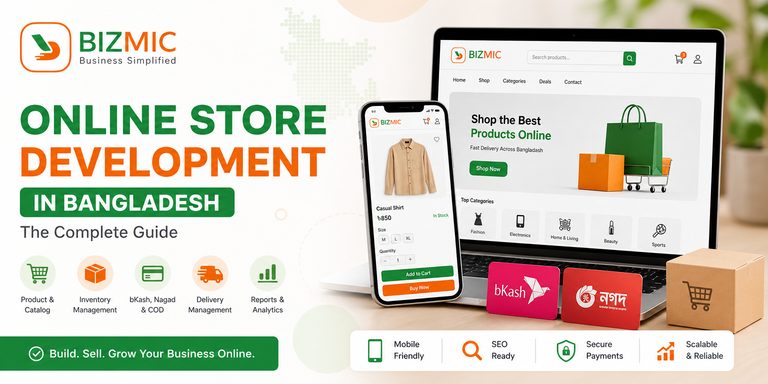
Ecommerce Website with bKash and Nagad Integration: Complete Guide for Bangladesh
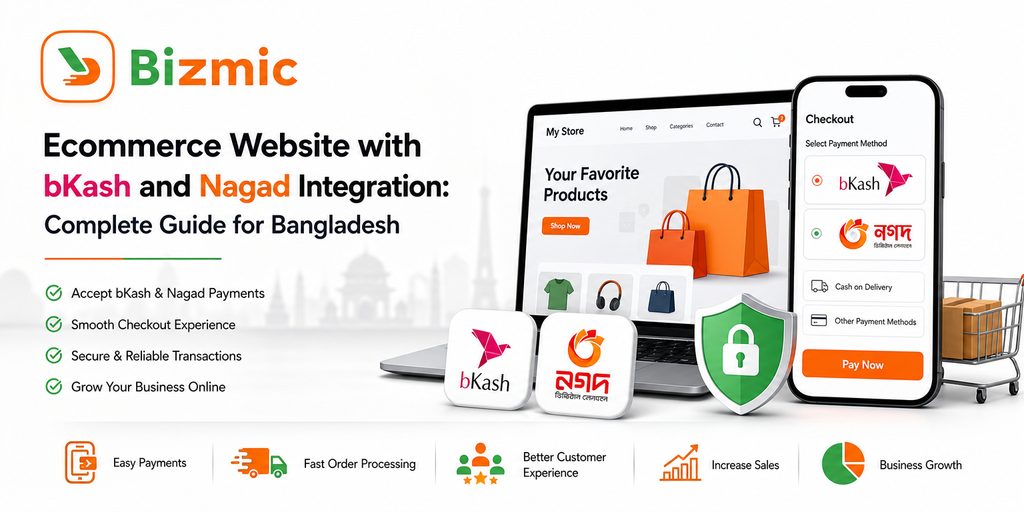
For many businesses in Bangladesh, the biggest hurdle in selling online is not building a website, it is getting paid the way local customers actually want to pay. An ecommerce website with bKash and Nagad integration lets a business accept two of the country’s most widely used mobile financial services directly at checkout, alongside cash on delivery and other options. This guide walks through what that integration actually involves, how it fits into a typical checkout flow, what to look for in a platform or development partner, and what tends to go wrong when the payment side is treated as an afterthought.
Quick Answer
- An ecommerce website with bKash and Nagad integration lets customers pay through Bangladesh’s leading mobile financial services directly during checkout, without leaving the site.
- Integration can happen through a direct provider connection or through a payment aggregator that bundles several gateways into one setup.
- A reliable implementation covers payment verification, order status synchronization, failed payment handling and reconciliation, not just a “pay now” button.
- There is no single fixed price for this kind of website. Cost depends on the platform, number of integrations and features required.
- Ready-made ecommerce platforms can launch faster, while custom development suits businesses with specific workflows or scale requirements.
What Is an Ecommerce Website with bKash and Nagad Integration?
An ecommerce website with bKash and Nagad integration is an online store where customers can complete payment using their bKash or Nagad mobile wallet directly from the checkout page, instead of relying only on cash on delivery or bank transfer. Both bKash and Nagad are mobile financial services widely used across Bangladesh, and connecting them to a store’s checkout means customers can pay in a few taps from an app they likely already use daily.
In practice, this integration sits between three systems: the ecommerce website itself, the payment provider’s platform, and the store’s order management backend. When these three are properly connected, a customer’s payment status is reflected in the order automatically, rather than requiring a staff member to manually confirm every transaction by phone or SMS.
Why bKash and Nagad Matter for Ecommerce in Bangladesh
Payment preference in Bangladesh’s ecommerce market leans heavily toward mobile financial services and cash on delivery, rather than credit or debit cards. Offering bKash and Nagad at checkout meets customers where they already are, since both services are used daily for bills, transfers and everyday purchases across the country.
For a growing online business, this matters in a few practical ways:
- Customers can pay using an app they already trust and understand, which can reduce hesitation at checkout.
- Digital payment confirmation can reduce reliance on cash handling and the risks that come with it, particularly for higher-value orders.
- A wider range of payment options gives customers flexibility, which can support a smoother checkout experience overall.
None of this guarantees higher sales on its own. Offering local, familiar payment methods can help remove friction at checkout, but conversion also depends on pricing, product fit, delivery reliability and overall site experience.
How bKash and Nagad Payment Integration Works
At a general level, most ecommerce payment integrations, including bKash and Nagad, follow a similar sequence during checkout. The exact technical details vary by provider and integration method, so this should be treated as a general explanation rather than an exact specification of any provider’s API.
1. The customer selects bKash or Nagad as the payment method at checkout.
2. The ecommerce system creates a payment request for the order amount and sends it to the payment provider.
3. The customer completes the payment through the bKash or Nagad app or interface, usually by confirming with a PIN or OTP.
4. The payment provider sends a confirmation back to the ecommerce system, indicating whether the transaction succeeded or failed.
5. The ecommerce system verifies this confirmation before treating the order as paid.
6. The order status is updated automatically, for example from “pending payment” to “confirmed”.
7. The customer receives a confirmation message or notification.
8. The admin can later reconcile the transaction against the payment provider’s records for accounting purposes.
Because exact integration requirements, available methods and documentation can change, it is worth verifying current technical details directly with bKash and Nagad before finalizing a build.
Key Benefits of bKash and Nagad Integration
When implemented properly, bKash and Nagad integration can offer several practical advantages for an ecommerce business:
- Payment convenience: customers can pay in a few steps without leaving the checkout page.
- A smoother checkout experience: fewer steps between “add to cart” and a confirmed order can help reduce drop-off.
- Reduced manual payment verification: automated confirmation can cut down on staff time spent checking payments by phone or SMS.
- Faster order processing: orders can move to fulfillment sooner once payment is verified automatically.
- More payment flexibility: customers can choose the method that suits them, rather than being limited to COD only.
- Better customer trust: a recognizable, familiar payment option at checkout may improve customer confidence in the store.
- Easier payment reconciliation: digital transaction records can simplify matching payments to orders during accounting.
- Improved operational efficiency: less manual work around payments generally frees up staff time for other parts of the business.
bKash vs Nagad for Ecommerce Payments
Both bKash and Nagad are established mobile financial services operating in Bangladesh, and both are commonly requested by customers at ecommerce checkout. The table below covers general, non-technical points of comparison. Specific fees, onboarding requirements, merchant account conditions and technical integration options change over time and should always be confirmed directly with each provider.
| Feature | bKash | Nagad |
| Type of service | Mobile financial service (MFS) | Mobile financial service (MFS) |
| Common use in Bangladesh | Widely used for bills, transfers and merchant payments | Widely used for bills, transfers and merchant payments |
| Ecommerce checkout use | Commonly offered as a checkout payment option | Commonly offered as a checkout payment option |
| Merchant onboarding | Requires a merchant or business account set up with the provider | Requires a merchant or business account set up with the provider |
| Fees and transaction charges | Set by the provider; confirm current rates directly | Set by the provider; confirm current rates directly |
| Official information source | bkash.com | nagad.com.bd |
In practice, many Bangladeshi ecommerce businesses offer both bKash and Nagad together rather than choosing one over the other, since customer preference between the two varies by individual and region.
Direct Integration vs Payment Aggregator
There are generally two approaches to connecting bKash and Nagad to an ecommerce website.
Direct Provider Integration
This means connecting the website directly to bKash’s and Nagad’s own merchant systems, typically after completing each provider’s merchant onboarding process. This approach can offer more control over the checkout experience, but it usually means managing two separate integrations, credentials and support relationships.
Payment Aggregator Integration
An aggregator is a third-party payment gateway service that bundles multiple payment methods, potentially including bKash, Nagad, cards and others, behind a single integration. This can simplify setup for a business that wants several payment options without managing each provider relationship separately, though it typically involves an additional layer of fees or terms set by the aggregator.
Which approach makes sense depends on the business’s scale, technical resources and how much control it needs over the checkout flow. Exact availability, onboarding steps, technical requirements and costs for either approach should be confirmed directly with the relevant provider or aggregator before committing to a build.
Essential Features of an Ecommerce Website with bKash and Nagad
Payment integration is only one part of a functional store. A well-built ecommerce website with bKash and Nagad support generally also needs:
- A mobile-friendly checkout, since most Bangladeshi shoppers browse and buy from phones
- A secure payment flow with encrypted connections throughout checkout
- Payment status verification before an order is marked as paid
- Order and payment synchronization so order status reflects actual payment status
- Clear handling of failed or incomplete payments, with an option to retry
- Refund support for cases where an order is cancelled or returned
- Transaction records that can be searched and exported for accounting
- Admin reporting on sales, payments and outstanding reconciliations
- Customer notifications for order and payment status updates
- Cash on delivery (COD) support alongside digital payment options
- Coupon and discount functionality for promotions
- Inventory synchronization so stock levels stay accurate across sales channels
- Order management tools covering the full journey from placement to delivery
- Delivery or courier integration where relevant
- SEO-friendly site architecture to support organic visibility
Common Problems with Ecommerce Payment Integration
Payment integration problems are one of the most common sources of customer complaints and lost orders for ecommerce businesses in Bangladesh. Being aware of these issues in advance makes it easier to ask the right questions before launch.
- Payment succeeds but the order stays pending: usually caused by a missed or delayed confirmation between the payment provider and the website.
- Duplicate payment attempts: can happen when a customer retries payment after an unclear error message, without knowing the first attempt actually went through.
- Failed transactions: may occur due to insufficient balance, incorrect PIN entry, or a timeout during the payment process.
- Network interruptions: a dropped connection mid-payment can leave both the customer and the system unsure of the outcome.
- Incorrect transaction status: happens when the website does not properly verify the payment confirmation it receives.
- Manual payment verification: relying on staff to check payments by phone slows down order processing and introduces human error.
- Poor mobile checkout: a checkout flow that is not optimized for mobile can cause customers to abandon payment midway.
- Inadequate error messages: vague error messages leave customers unsure whether to retry, wait, or contact support.
- Missing reconciliation tools: without proper transaction records, matching payments to orders becomes a manual, error-prone task.
- Weak security practices: poor handling of payment credentials or data increases risk for both the business and its customers.
Most of these issues can be reduced with proper server-side payment verification, clear customer-facing error messages, and a checkout flow that has been tested under real network conditions before launch.
Security Considerations for bKash and Nagad Payment Integration
Payment security is not optional for an ecommerce website handling bKash and Nagad transactions. At a general level, businesses and their development partners should ensure:
- HTTPS/SSL is enforced across the entire website, especially the checkout and payment pages
- API credentials for payment providers are stored securely and never exposed in client-side code
- Payment confirmation is verified server-side, not just trusted from the customer’s browser
- Webhook or callback data from payment providers is validated before being acted on
- Payment status is checked against the provider’s records rather than assumed
- Access to payment and order data is restricted through proper admin role controls
- Logs are handled securely and do not store sensitive payment details unnecessarily
- Sensitive payment information is not stored on the website’s own servers beyond what is required
- Software, plugins and dependencies are kept updated to patch known vulnerabilities
These practices apply broadly across payment integrations, not only bKash and Nagad. Any development partner working on payment integration should be able to explain how they handle each of these points.
What Should You Look for in an Ecommerce Platform?
Whether comparing ready-made platforms or evaluating a custom build, this checklist covers the practical points worth confirming:
- Compatibility with bKash and Nagad, and clarity on how that integration is set up
- Mobile-first design, since most traffic in Bangladesh comes from phones
- An admin dashboard that covers orders, products, payments and customers in one place
- Solid order management, from placement through to delivery
- Inventory management that stays accurate as orders come in
- Payment reporting for reconciliation and accounting
- Delivery or courier integration where relevant to the business
- SEO-friendly structure, including clean URLs and editable metadata
- Analytics to track sales and customer behavior
- Security practices covering SSL, data handling and updates
- Scalability to handle growing product catalogs and order volume
- Room for customization as the business’s needs change
- Ongoing technical support after launch
- Clarity on source code and data ownership before committing to a platform
Ready-Made Ecommerce Platform vs Custom Ecommerce Website
Choosing between a ready-made platform and a fully custom build usually comes down to budget, timeline and how specific the business’s workflow needs are.
| Factor | Ready-Made Platform | Custom Development |
| Initial cost | Generally lower upfront cost | Generally higher upfront investment |
| Launch speed | Faster, often days to a few weeks | Slower, often several weeks to months |
| Customization | Limited to the platform’s built-in options and modules | Can be tailored closely to a specific workflow |
| Maintenance | Often simpler, with platform-level updates | Requires a dedicated maintenance plan |
| Scalability | Can hit limits as the business grows, depending on the platform | Can be built with future scale in mind |
| Payment integration | Usually supports common gateways through built-in modules | Any provider or method can be integrated, at added cost and time |
| Feature flexibility | Limited to what the platform already supports | Fully flexible, built around business needs |
| Technical requirements | Lower technical overhead to get started | Requires more planning, development and testing |
Neither option is universally better. A new seller testing demand may be better served by a ready-made platform, while an established business with specific operational requirements may find more long-term value in custom development.
How Much Does an Ecommerce Website with bKash and Nagad Integration Cost in Bangladesh?
There is no single fixed price for an ecommerce website with bKash and Nagad integration. The final cost depends on several factors specific to the business, and any provider quoting a price without understanding these details should be treated with some caution.
Factors that typically influence the cost include:
- The type of website: a simple storefront versus a fully custom or multi-vendor platform
- Design complexity: template-based design versus a fully custom UI/UX
- The number of products and how the catalog needs to be structured
- How many payment integrations are needed, and whether that includes direct provider connections or an aggregator
- Courier or delivery integrations for order tracking
- Custom features beyond a standard storefront, such as subscriptions or loyalty programs
- The complexity of the admin panel and reporting needs
- Hosting, since traffic and storage needs affect ongoing cost
- Security measures, including SSL and fraud prevention
- Ongoing maintenance and support after launch
- Any third-party services connected to the store
A more detailed breakdown of typical pricing ranges, cost components and what drives them up or down is covered in Bizmic’s ecommerce website development cost guide for Bangladesh. Since every business has different requirements, it is worth requesting a project-specific quote rather than relying on a generic number.
Why Choose a Bangladesh-Ready Ecommerce Solution?
A generic ecommerce template built for a different market often needs significant rework before it fits how Bangladeshi customers actually shop and pay. A Bangladesh-ready solution generally accounts for:
- Local payment methods, including bKash and Nagad, alongside card options where relevant
- Cash on delivery (COD), which remains a widely used payment method across the country
- Pricing and reporting in BDT by default
- Support for local courier and delivery services
- A checkout and browsing experience built mobile-first
- Bangla and English language support where relevant to the customer base
- Workflows that reflect how local businesses actually operate, from order confirmation calls to zone-based delivery
Considering these factors early, rather than adding them after launch, tends to save both time and rework.
Quick Ecommerce by Bizmic
Bizmic is a Bangladesh-based technology company (see bizmic.com) that builds both custom web applications and ready-to-deploy ecommerce and retail software. For businesses that want to launch without building every part of an ecommerce system from scratch, Quick Ecommerce is a React-based multi-vendor marketplace script from Bizmic. It ships with an admin panel, seller panel, a customer-facing website, a customer app, a seller app and a deliveryman app, already connected as one package, along with source code and documentation.
It is built primarily for businesses running or planning a multi-vendor marketplace model, such as grocery, food delivery, pharmacy, pet supply or general retail businesses that want each vendor to manage their own products and orders through a dedicated seller panel, while the admin controls zones, categories and platform-wide settings from one dashboard.
On the payment side, Quick Ecommerce includes a payment gateways module that allows multiple secure payment gateways to be configured from the admin panel. Since exact gateway availability can be updated over time, businesses evaluating whether bKash and Nagad specifically fit their configuration should confirm current gateway support directly with Bizmic before purchase.
For businesses considering a single-brand online store combined with physical retail operations rather than a multi-vendor marketplace, a single-vendor ecommerce software approach may be a better starting point, and is worth comparing separately.
A ready-built platform like this can be a practical starting point for founders who want a production-ready marketplace without a lengthy custom build, particularly when weighed against the Quick Ecommerce page’s own feature and demo details.
Questions to Ask Before Choosing an Ecommerce Development Company
Price is rarely the only factor worth comparing. Before committing to a platform or a development partner, it is worth asking:
- Have you integrated bKash and Nagad on previous ecommerce projects, and can you show an example?
- Do you support direct provider integration, aggregator integration, or both?
- How is payment status verified and synchronized with order status?
- What happens when a payment fails or a network interruption occurs mid-checkout?
- Is refund handling included, and how does it work in practice?
- What reconciliation and reporting tools are available for tracking payments against orders?
- How is payment and API credential security handled?
- Will I own the source code and my store’s data after the project is complete?
- What is included in the quoted price, and what is billed separately?
- What ongoing maintenance and support is included after launch, and for how long?
- How long will the full build and integration realistically take?
- Can the platform scale if my order volume or product catalog grows significantly?
Final Thoughts
An ecommerce website with bKash and Nagad integration is less about adding a payment button and more about building a checkout flow that verifies payments correctly, keeps order status accurate, and gives the business reliable records to work from. If you are planning an ecommerce website with local payment options, take time to evaluate the payment workflow, checkout experience, order management and long-term scalability before choosing a platform or partner.
For businesses that want to launch a multi-vendor marketplace without building every panel and app from scratch, it is worth exploring Quick Ecommerce to see whether a ready-built, connected platform fits your business plans.
Frequently Asked Questions
More Posts
- Custom Ecommerce Website Price in BD: A Complete Cost Guide
 Shiblur Rahman Lipu
 - Ecommerce Website with bKash and Nagad Integration: Complete Guide for Bangladesh
 Shiblur Rahman Lipu
 - Online Store Development in Bangladesh: The Complete Guide
 Shiblur Rahman Lipu
 - Ecommerce Website Development Cost in Bangladesh: Complete Price Guide
 Shiblur Rahman Lipu
 - Single Vendor Ecommerce Software in Bangladesh: Complete Buying Guide | Quick Ecommerce
 Single Vendor Ecommerce Software in Bangladesh: Complete Buying Guide Introduction Single vendor ecommerce software in Bangladesh is a system that… Read more: Single Vendor Ecommerce Software in Bangladesh: Complete Buying Guide | Quick Ecommerce
Stay Connected
for Newsletter

We build software that helps businesses launch faster, operate smarter, and grow bigger.


Get Help