Online Store Development in Bangladesh: The Complete Guide
Online store development in Bangladesh is the process of planning, designing, building, integrating, and launching a website (or app) where a business can sell products directly to customers, accept local payments, and manage orders from a single admin panel. For Bangladeshi business owners, it matters because it replaces manual order-taking on Facebook and WhatsApp with a system that can track inventory, process bKash and Nagad payments, and scale beyond what a phone and a notebook can handle. This guide walks through what online store development actually involves, what it costs, which features matter, and how to choose the right development approach for your business.
What Is Online Store Development?
Online store development is the end-to-end process of turning a business idea into a functioning ecommerce website: designing the storefront, building the backend that manages products and orders, integrating payment and delivery systems, testing everything, and deploying it so customers can actually place orders.
It is broader than “building a website.” A basic informational website only needs pages and content. An online store needs a product catalog, a shopping cart, checkout logic, payment processing, order tracking, and an admin panel that a non-technical staff member can operate daily. That combination of customer-facing storefront and business-facing admin system is what separates ecommerce development from general web design.
In Bangladesh specifically, online store development also has to account for local realities from day one: Cash on Delivery as a primary payment method, mobile financial services like bKash and Nagad, courier logistics that differ inside and outside Dhaka, and a customer base that browses primarily on mobile phones.
Why Bangladeshi Businesses Need an Online Store
A large share of small and mid-sized businesses in Bangladesh currently sell through Facebook Pages, WhatsApp, or phone calls without any dedicated software. This works at low volume, but it creates predictable problems as a business grows:
- No structured inventory tracking, which leads to overselling out-of-stock items
- Orders tracked manually in notebooks or spreadsheets, prone to errors and lost orders
- Difficulty reconciling Cash on Delivery collections against actual orders
- No centralized customer records, so repeat customers are not easy to identify or reward
- Manual coordination with courier services for every single delivery
- No searchable product catalog, so customers scroll through old Facebook posts to find items
- Limited ability to run discounts, flash sales, or structured promotions
- No sales reporting, so decisions are based on memory rather than data
Mobile financial services have also become central to how Bangladeshi consumers pay for things online. Bangladesh Bank data reported by The Financial Express shows MFS accounts and transaction volumes have continued to grow year over year, which reflects why bKash and Nagad integration is now considered a baseline requirement rather than an optional extra for a Bangladeshi online store.
A dedicated online store does not replace Facebook as a discovery channel. In practice, most Bangladeshi businesses use both together: Facebook and Instagram for reach, and a proper online store for ownership, structure, and long-term growth.
Online Store vs Facebook Selling: What Is the Real Difference?
An online store gives a business full ownership of its branding, product catalog, and customer data, while Facebook selling depends on a platform the business does not control and offers limited tools for inventory, checkout, or SEO.
| Factor | Own Online Store | Facebook Selling Only |
| Ownership | Fully owned by the business | Dependent on Facebook’s platform and policies |
| Branding | Fully customizable domain, design, and identity | Limited to Facebook Page format |
| Customer data | Business owns and controls customer records | Largely retained by Facebook |
| Product management | Structured catalog with categories and variants | Manual posts, difficult to organize at scale |
| Inventory | Real-time stock tracking | Manual, no automated stock control |
| Checkout | Structured cart and checkout flow | Manual order confirmation via comments or chat |
| Payment | bKash, Nagad, cards, and COD integrated directly | Payments usually arranged manually outside the platform |
| SEO | Can rank on Google for product and category searches | Not discoverable through search engines |
| Scalability | Built to handle growing order volume | Becomes unmanageable at higher order volume |
| Long-term business value | Builds a durable, sellable digital asset | Tied entirely to a third-party platform |
For most growing businesses, the practical answer is not “online store instead of Facebook” but “online store in addition to Facebook,” with social channels feeding traffic into a system built to actually process and fulfill orders.
Types of Online Stores for Bangladeshi Businesses
Choosing the right store type depends on how many sellers will use the platform and who owns the products being sold.
Single-Vendor Online Store
A single-vendor store is a system where one business, whether a brand, retailer, manufacturer, or wholesaler, sells only its own products through one admin panel. This is the right model for most Bangladeshi SMEs, D2C brands, and retailers digitizing an existing shop. A detailed breakdown of features, pricing models, and Bangladesh-specific requirements for this model is covered in this single-vendor ecommerce software guide.
Multi-Vendor Marketplace
A multi-vendor marketplace hosts multiple independent sellers on one platform, each managing their own listings, typically with the platform earning a commission per sale. This model requires more admin infrastructure: seller onboarding, vendor dashboards, commission logic, and payout management. It suits founders building a platform that connects many sellers to buyers, not a single brand selling its own catalog.
B2C, B2B, and D2C Stores
A B2C (business-to-consumer) store sells directly to individual shoppers, which describes most fashion, electronics, and daily essentials stores in Bangladesh. A B2B (business-to-business) store sells to other businesses, often with bulk pricing, quote requests, and account-based ordering. A D2C (direct-to-consumer) store is typically run by a manufacturer or wholesaler that has traditionally sold through distributors and is now selling directly to end customers online, cutting out the middle layer.
Single-Vendor vs Multi-Vendor: Side-by-Side Comparison
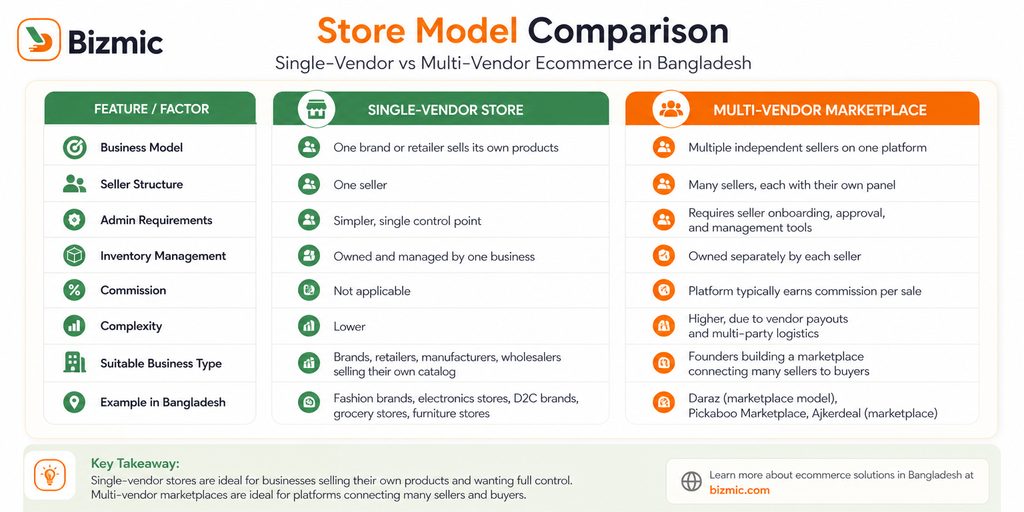
| Factor | Single-Vendor | Multi-Vendor |
| Business model | One brand or retailer sells its own products | Multiple independent sellers on one platform |
| Seller structure | One seller | Many sellers, each with their own panel |
| Admin requirements | Simpler, single control point | Requires seller onboarding, approval, and management tools |
| Inventory | Owned and managed by one business | Owned separately by each seller |
| Commission | Not applicable | Platform typically earns commission per sale |
| Complexity | Lower | Higher, due to vendor payouts and multi-party logistics |
| Suitable business type | Brands, retailers, manufacturers, wholesalers selling their own catalog | Founders building a marketplace connecting many sellers to buyers |
Businesses evaluating a single-brand system that also needs to unify online sales with physical store operations often look at a combined platform like Retail Master, which brings online storefront, point-of-sale, and multi-branch inventory together under one system.
Ready-Made vs Custom Ecommerce Development
Ready-made ecommerce platforms launch faster and cost less upfront, while custom development takes longer to build but offers more control over features, integrations, and long-term scalability.
| Factor | Ready-Made / Off-the-Shelf | Custom Development |
| Cost | Lower upfront investment | Higher upfront investment |
| Launch time | Days to a few weeks | Several weeks to a few months |
| Customization | Limited to the platform’s built-in options | Fully tailored to a specific workflow |
| Scalability | Can hit architectural limits as order volume grows | Can be designed for a specific scale from the start |
| Integrations | Limited to available plugins or modules | Any system can be integrated by design |
| Maintenance | Often handled or simplified by the vendor | Requires an ongoing maintenance plan |
| Best use case | New sellers, small catalogs, fast validation of an idea | Established businesses with specific operational or integration needs |
A practical middle path that many Bangladeshi businesses choose is a production-ready platform with full source code, such as a script-based multi-vendor solution, that is then customized to match specific branding and workflow needs, rather than building everything from a blank codebase.
Essential Features Every Online Store Needs
Regardless of budget or platform choice, certain features form the operational core of any functional online store.
Product and Catalog Management
Categories, subcategories, product variants (size, color, unit), bulk upload via spreadsheet, and the ability to publish or hide products without developer involvement.
Inventory Management
Real-time stock tracking, low-stock alerts, and support for multiple warehouses or branches where relevant. This directly prevents overselling, one of the most common complaints in Bangladeshi online retail.
Order Management
A clear order pipeline from placement to confirmation, shipment, and delivery, including support for cancellations, returns, and partial fulfillment.
Customer Management
Structured customer profiles and order history, which make repeat-customer marketing and support far more practical than scattered chat threads.
Payment Gateway Integration
Support for bKash, Nagad, card payments (commonly routed through a licensed aggregator such as SSLCommerz), and Cash on Delivery. Payment options should be confirmed and tested directly with each provider rather than assumed from general marketing claims.
Courier and Delivery Integration
Connections to courier services for shipment booking, tracking, and status updates, along with zone-based delivery charge rules that reflect the real difference between delivering inside Dhaka and outside Dhaka.
SEO Foundations
Clean URLs, editable meta titles and descriptions, fast page load speed, and structured data, all of which support long-term organic visibility on Google.
Security
SSL encryption, secure checkout, regular security patching, and controlled admin access with role-based permissions.
Analytics and Reporting
Sales dashboards, product and category-wise performance, and customer behavior insights that support decisions based on data rather than guesswork.
Social Commerce Integration
Since a large share of Bangladeshi product discovery still happens on Facebook and Instagram, connecting the store’s catalog to social channels helps capture buyers where they already spend time.
ERP and POS Integration
For businesses running physical stores alongside an online presence, syncing inventory and sales data between POS or ERP systems and the online store avoids duplicate data entry and mismatched stock counts.
Bangladesh-Specific Requirements for Online Store Development
A platform or development approach built generically for global markets can miss details that matter specifically in Bangladesh. Look for and plan around the following:
- Cash on Delivery (COD): still one of the most trusted payment methods for Bangladeshi online shoppers, and it needs proper reconciliation tools, not just an on/off toggle
- bKash and Nagad: the two largest mobile financial services in the country; confirm the specific integration is live and tested, not just listed as a feature
- Card and internet banking payments: usually processed through a licensed payment service operator such as SSLCommerz rather than connecting directly to card networks
- Courier integration: connect with courier partners that actually operate the routes your customers are in, and confirm delivery charge logic for inside Dhaka versus outside Dhaka
- Mobile-first design: the majority of Bangladeshi ecommerce browsing happens on smartphones, making mobile performance a requirement, not an enhancement
- Facebook-driven discovery: many customers still find products through social feeds before purchasing on the website, so catalog sync with Facebook and Instagram matters
- Bangla and English content: bilingual storefronts serve a wider customer base and reduce friction during checkout
- Pricing in BDT: currency should be native to the platform, not an afterthought retrofitted from a foreign-market template
- Return and refund workflow: a clear, written policy and a system to track returns reduces disputes and builds trust
- Customer support channels: phone and messaging support in Bangla and English, since many customers still prefer speaking to someone directly before or after ordering
- Security and data protection: encrypted checkout and controlled access to customer data, particularly payment and delivery information
On tax matters specifically: ecommerce platforms may support VAT-inclusive pricing fields and basic invoice formatting, but this article is not tax or legal advice. VAT registration and compliance requirements should be confirmed directly with a qualified accountant or the National Board of Revenue.
The Online Store Development Process
A typical online store development project moves through the following stages, whether built on a ready-made platform or fully custom.
- Business requirement analysis: defining what the store needs to do, who will use it, and what integrations are required
- Feature planning: deciding which features are essential at launch versus which can be added later
- Platform or technology selection: choosing between a ready-made script, a SaaS platform, or a fully custom build
- UX/UI design: designing the storefront and admin panel around how customers and staff will actually use them
- Frontend development: building the customer-facing storefront, including product pages, cart, and checkout
- Backend development: building the admin panel, database, and business logic that powers the store
- Payment integration: connecting and testing bKash, Nagad, card payments, and COD workflows
- Courier integration: connecting delivery partners and configuring zone-based shipping rules
- Inventory and order system setup: configuring stock rules, order statuses, and notification workflows
- SEO setup: implementing clean URLs, meta tags, and technical SEO foundations before launch
- Security implementation: SSL, secure checkout, and access control configuration
- Testing: placing test orders through the full checkout, payment, and fulfillment flow to catch issues before real customers do
- Deployment: launching the store on production servers
- Staff training: making sure the team can actually operate the admin panel day to day
- Post-launch maintenance and optimization: fixing issues, applying updates, and refining based on real usage data
How Much Does Online Store Development Cost in Bangladesh?
Online store development cost in Bangladesh depends heavily on the platform chosen, the number of products, which payment and courier integrations are needed, and how much custom functionality the business requires. A basic store built on a ready-made platform costs far less than a fully custom multi-vendor marketplace, and the gap between the two can be substantial.
Rather than duplicating the full pricing breakdown here, this ecommerce website development cost in Bangladesh guide covers detailed price ranges by store type, a full cost breakdown by component, hidden costs businesses often miss, and a first-year total cost formula worth reviewing before requesting vendor quotes.
As a general planning principle, always ask for an itemized quote rather than a single lump-sum figure, and confirm which costs are one-time (design, development) versus recurring (hosting, domain, SSL, maintenance, payment gateway fees).
How Long Does It Take to Develop an Online Store in Bangladesh?
A basic online store on a ready-made platform can realistically launch within two to four weeks, while a custom platform or multi-vendor marketplace typically takes two to six months depending on complexity and the number of integrations required.
Timelines stretch when a project adds custom features, multiple courier and payment integrations, ERP or POS syncing, or a fully bespoke design. Any provider promising a complex custom marketplace in one or two weeks is usually skipping steps that surface as problems after launch, particularly around payment reconciliation and inventory accuracy.
SEO, AEO, and AI Search Optimization for Online Stores
SEO (search engine optimization) helps an online store appear in Google results when Bangladeshi customers search for products, while AEO (answer engine optimization) and GEO (generative engine optimization) help the same content get surfaced or cited by AI-powered search and chat tools.
The technical foundations overlap significantly. Following Google Search Central documentation for clean URLs, structured data, mobile usability, and page speed benefits both traditional search rankings and how well AI systems can parse and summarize a store’s content.
Practical steps that support both traditional SEO and AI-search visibility include:
- Writing direct, clear answers to common customer questions (shipping, returns, payment methods) instead of vague marketing copy
- Using structured headings, bullet lists, and tables rather than dense unbroken paragraphs
- Maintaining consistent business information (name, location, offerings) across every page
- Implementing schema markup for products, organization details, and FAQs where applicable
- Publishing genuinely original policies, pricing, and product information rather than copied template content
- Keeping page speed and mobile responsiveness a priority, since both are ranking and usability factors
The goal is not to manipulate any particular search or AI system, but to make a store’s information clear, accurate, and well-structured enough that both humans and machines can understand it correctly.
How to Choose an Online Store Development Company in Bangladesh
Price should not be the only factor when comparing development companies. The following criteria matter more over the life of the store:
- Ecommerce-specific portfolio: look for actual online store projects, not just general websites
- Payment and courier experience: ask specifically which gateways and couriers they have integrated before, not just what they claim to support
- Technology stack: confirm what the store is built with and whether that stack is actively maintained
- Scalability: ask what happens to the system at ten times the current order volume
- Security practices: ask directly how SSL, data protection, and update cycles are handled
- Post-launch support: confirm exactly what is included in maintenance and what is billed separately
- Source code and data ownership: get in writing that the business owns its code and customer data, not just a license to use a hosted system
- Pricing transparency: an itemized quote is a good sign; a vague lump-sum figure is a warning sign
Worth asking directly before signing: What exactly is included in the quoted price? Who owns the source code after completion? What happens if changes are needed after launch? How long does included maintenance last, and what happens after it ends?
Common Online Store Development Mistakes to Avoid
- Choosing only based on price: the cheapest quote often has expensive gaps that surface later
- Ignoring mobile UX: testing only the desktop version while most customers will shop on a phone
- No proper inventory system: leads to overselling and cancelled orders
- No payment integration plan: launching without confirming bKash, Nagad, or card payments actually work end to end
- No courier workflow: manually coordinating every delivery instead of integrating a courier partner
- Poor product architecture: disorganized categories that make products hard to find and hurt SEO
- Ignoring SEO from the start: treating SEO as an afterthought after launch instead of building it into the site structure
- Weak security: skipping SSL, secure checkout, or regular security patching
- No backup strategy: risking total data loss from a single server issue
- No analytics setup: launching without any way to measure traffic, conversion, or drop-off points
- No maintenance plan: assuming the store will run itself indefinitely after launch
- Building unnecessary features before launch: delaying go-live for features that could be added after real customer feedback
- No scalability planning: not asking what happens at higher order volumes until it becomes an emergency
- Not checking source code and data ownership: discovering after the fact that the business does not fully own its own store
Post-Launch: Maintenance, Security, and Scalability
Launching an online store is the beginning of an ongoing responsibility, not the end of the project. Security patches, bug fixes, and platform updates need to continue after go-live, and most businesses benefit from a defined maintenance and support plan rather than handling issues reactively as they appear.
As order volume grows, scalability considerations shift from “does the site work” to “does the site work under real load”: can the hosting handle traffic spikes during campaigns, can the database handle a growing product catalog, and can the admin panel support more staff accounts without becoming a bottleneck. Planning for this early, even if the business is small today, avoids a costly rebuild later.
Why Choose Bizmic for Online Store Development in Bangladesh?
Bizmic is a Bangladesh-based technology company offering both ready-to-deploy ecommerce products and custom development services, which gives businesses more than one path depending on what they actually need.
For businesses that sell their own catalog and want a single-brand system, Retail Master combines an online storefront, point-of-sale, inventory control, and multi-branch management in one platform, so online and offline stock and sales stay in sync. For founders building a platform with multiple independent sellers, Quick Ecommerce is a production-ready multi-vendor marketplace script with an admin panel, seller panel, customer app, and delivery app already connected.
For businesses that need something built specifically around their own workflow, Bizmic’s web development and custom product development teams build ecommerce systems from the ground up, covering product catalogs, secure checkout, and payment gateway integration. Beyond the initial build, Bizmic also provides API integration for connecting payment gateways, ERPs, and CRMs, customization services for adapting existing products to a specific brand, and ongoing maintenance and support to keep a store secure and running after launch.
Bizmic does not present one option as universally best. Whether a ready-made platform or a custom build fits better depends on catalog size, budget, timeline, and how specific the required workflow is, which is exactly the kind of decision worth discussing directly with a development team before committing.
Frequently Asked Questions
More Posts
- Custom Ecommerce Website Price in BD: A Complete Cost Guide
 Shiblur Rahman Lipu
 - Ecommerce Website with bKash and Nagad Integration: Complete Guide for Bangladesh
 Shiblur Rahman Lipu
 - Online Store Development in Bangladesh: The Complete GuideShiblur Rahman Lipu
- Ecommerce Website Development Cost in Bangladesh: Complete Price Guide
 Shiblur Rahman Lipu
 - Single Vendor Ecommerce Software in Bangladesh: Complete Buying Guide | Quick Ecommerce
 Single Vendor Ecommerce Software in Bangladesh: Complete Buying Guide Introduction Single vendor ecommerce software in Bangladesh is a system that… Read more: Single Vendor Ecommerce Software in Bangladesh: Complete Buying Guide | Quick Ecommerce
Stay Connected
for Newsletter

We build software that helps businesses launch faster, operate smarter, and grow bigger.


Get Help