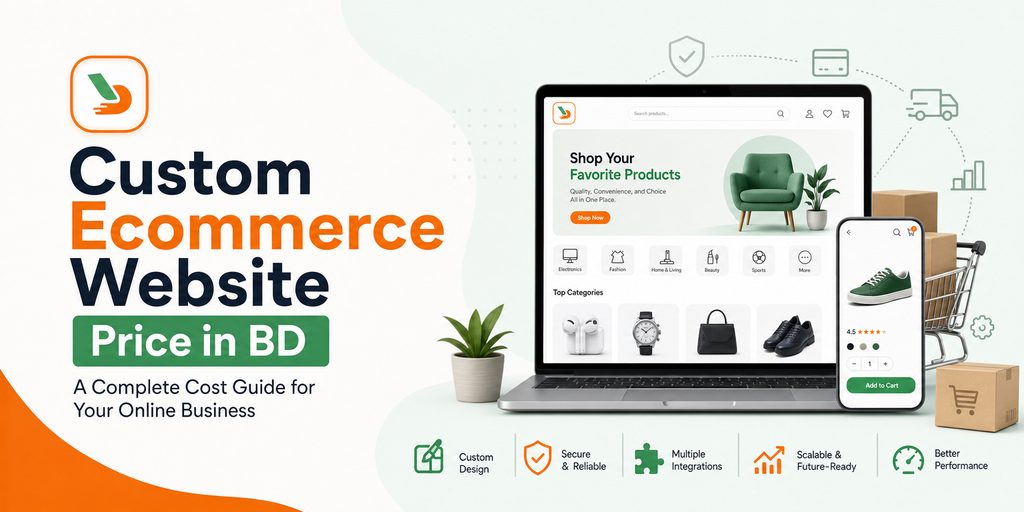
Custom Ecommerce Website Price in BD: A Complete Cost Guide
If you have asked a few developers or agencies about the custom ecommerce website price in BD, you have probably received wildly different quotes. One agency quotes BDT 40,000. Another quotes BDT 8,00,000. Both are technically building an “ecommerce website,” yet the outcomes are not comparable.
This guide explains what actually drives custom ecommerce pricing in Bangladesh, what you get at each price level, and how to evaluate a development quotation with confidence before you commit your budget.
How Much Does a Custom Ecommerce Website Cost in Bangladesh?
A genuinely custom ecommerce website in Bangladesh typically costs between BDT 80,000 and BDT 15,00,000 or more, depending on design complexity, backend architecture, integrations (payment gateways, courier services, inventory or POS systems, ERP/CRM), security requirements, and long-term scalability needs. Basic customized stores sit at the lower end of this range, while advanced multi-integration platforms with custom dashboards and enterprise-grade architecture sit at the higher end.
These figures are indicative, market-oriented estimates, not fixed or guaranteed pricing from any single vendor. Actual pricing depends on your specific scope, and you should always request a written quotation based on your business requirements.
What Exactly Is a Custom Ecommerce Website?
A custom ecommerce website is built (or substantially engineered) around a specific business’s workflow, rather than assembled from a fixed template or a one-size-fits-all SaaS package. The codebase, database structure, admin dashboard, and business logic are shaped around how your business actually operates: your product catalog, your pricing rules, your fulfillment process, your integrations, and your growth plans.
This is different from a few related, and often confused, categories:
- Template-based website: A pre-built design with limited structural changes. Fast and inexpensive, but flexibility is constrained by the template.
- SaaS ecommerce platform: A hosted, subscription-based platform (you rent the infrastructure and pay recurring fees; deep backend customization is usually restricted by the platform provider).
- Ready-made ecommerce software: Pre-built, self-hosted or licensed software that can be configured and moderately customized, but is not engineered from the ground up for one business.
- Custom ecommerce website: Purpose-built for one business. Full control over source code, architecture, integrations, and future changes.
The keyword phrase “custom ecommerce website price in BD” almost always reflects buyers trying to understand what separates these categories in terms of both capability and cost.
Custom Ecommerce Website Price in Bangladesh: Pricing Ranges
Because “custom” can mean a small amount of customization on top of an existing system, or a fully bespoke platform built from scratch, it is useful to think in tiers rather than a single number. The ranges below are indicative market estimates for the Bangladesh context, not fixed prices, and assume a single-vendor (single-brand) store unless stated otherwise.
| Tier | Indicative Price Range (BDT) | Best For |
| Basic customized ecommerce | 80,000 – 2,50,000 | Small retailers or startups needing a functional, branded store with core features and moderate customization |
| Professional custom ecommerce | 2,50,000 – 6,00,000 | Growing SMEs needing multiple integrations (payment, courier), custom UI/UX, and a tailored admin panel |
| Advanced custom ecommerce | 6,00,000 – 15,00,000 | Established businesses needing ERP/CRM/POS integration, advanced catalog logic, and high-performance architecture |
| Enterprise-level ecommerce | 15,00,000 and above | Large or multi-brand operations needing custom scalability, dedicated infrastructure, and complex business workflows |
A BDT 50,000 website and a BDT 5,00,000 website can both be marketed as “ecommerce websites,” but they are not the same product. The BDT 50,000 build is usually a lightly customized template with basic cart and checkout functionality. The BDT 5,00,000 build typically includes custom-coded modules, multiple live integrations, a tailored admin dashboard, structured database design for scale, and dedicated development and QA time. The price difference reflects engineering effort, not just branding.
What Determines Custom Ecommerce Website Cost?
Custom ecommerce pricing is driven by a combination of design, engineering, integration, and operational requirements. The sections below break down the main cost factors.
Design and Frontend
- UI/UX design: Wireframing, custom visual design, and usability testing add cost but directly affect conversion rates.
- Frontend development: Custom-coded interfaces (built with frameworks such as React or Vue.js) cost more than template-driven frontends but offer better performance and flexibility.
- Mobile responsiveness and, where required, a dedicated mobile app (for example using Flutter) for a native shopping experience.
Backend, Database, and Architecture
- Backend development: Business logic, order processing, pricing rules, and user roles are coded around your actual workflow (commonly built on frameworks such as Laravel/PHP).
- Database architecture: How products, variants, inventory, and orders are structured affects both performance and future scalability.
- Product and catalog complexity: Simple catalogs cost less than catalogs with variants, bundles, bulk pricing, or configurable products.
Integrations
- Payment gateways: Integration with bKash, Nagad, Rocket, SSLCommerz, or card-based gateways, each with its own API documentation and testing requirements.
- Courier and shipping integrations: Connecting to courier partners for order tracking and automated status updates.
- Inventory management and POS integration: Important for businesses that also sell through physical stores and need synchronized stock.
- ERP/CRM/accounting integration: Connecting ecommerce data with existing business systems to avoid duplicate data entry.
Admin Tools, Security, and Performance
- Custom admin dashboards: Reporting, role-based access, and business-specific controls beyond default ecommerce admin panels.
- Customer account features: Order history, wish lists, loyalty logic, and saved addresses.
- Security: Secure authentication, data protection practices, and safe handling of payment-related data.
- Performance optimization: Caching, image optimization, and server configuration to keep load times low, which also affects Core Web Vitals and search visibility.
- SEO architecture: Clean URL structures, structured data, and crawlable page architecture built in from the start rather than retrofitted.
Performance is not a cosmetic concern. Google’s own guidance on Core Web Vitals explains how loading speed and interactivity directly influence both user experience and search ranking, which is one reason custom-built performance optimization is often worth the additional engineering cost.
Custom vs Ready-Made Ecommerce Website
| Aspect | Custom Ecommerce Website | Ready-Made / Template Ecommerce |
| Source code ownership | Full ownership, unless otherwise agreed | Often limited or license-restricted |
| Customization depth | Unlimited, engineered to your workflow | Limited to what the template or platform allows |
| Initial cost | Higher | Lower |
| Long-term flexibility | High, scales with the business | Constrained by the underlying platform |
| Development time | Longer (weeks to months) | Shorter (days to weeks) |
| Best suited for | Businesses with specific workflows or growth plans | Businesses needing a fast, simple online presence |
Single-Vendor vs Multi-Vendor Ecommerce Cost
The pricing ranges above generally assume a single-vendor store: one business selling its own products under one brand. A multi-vendor marketplace, where multiple independent sellers list and manage their own products, is a materially different and more expensive engineering problem.
- Multi-vendor platforms require separate seller dashboards, commission logic, seller-specific order and payout management, and more complex permission systems.
- Multi-vendor systems typically demand more rigorous testing because a single bug can affect many sellers at once.
- As a result, multi-vendor marketplace development generally costs meaningfully more than an equivalent single-vendor build.
Many Bangladeshi retailers, especially those already running a physical shop alongside their online store, do not actually need a multi-vendor marketplace. A single vendor ecommerce and retail management solution is often a more cost-effective and operationally simpler fit, since it is purpose-built around one business managing both online and offline sales rather than an open marketplace model.
Technology Stack and How It Affects Price
The technologies used to build your store affect both upfront cost and long-term maintainability. Common choices for custom ecommerce in Bangladesh include:
- PHP/Laravel: A mature, widely supported backend framework often used for custom ecommerce logic and admin systems.
- React or Vue.js: Modern frontend frameworks used to build fast, interactive storefronts.
- Flutter: Used when a business also needs a native mobile shopping app alongside the website.
- Firebase or similar backend services: Sometimes used for specific features such as real-time notifications.
A modern, well-structured stack usually costs more upfront than a quick template installation, but tends to reduce long-term technical debt, since the code is easier to extend as the business grows.
One-Time Development Cost vs Recurring Ecommerce Costs
The initial development price is only part of the total cost of ownership. Ecommerce websites also carry ongoing costs that should be budgeted for from the start.
| Cost Type | Examples | Frequency |
| One-time development | Design, coding, integrations, testing, deployment | Paid once at project delivery |
| Hosting and infrastructure | Server, CDN, SSL certificate | Monthly or annually |
| Domain and email | Domain registration, business email hosting | Annually |
| Payment gateway fees | Transaction fees charged by gateway providers | Per transaction |
| Maintenance and support | Bug fixes, security patches, minor updates | Monthly, quarterly, or as needed |
| Future customization | New features, integrations, or redesigns | As required |
Businesses that only budget for the initial build often underestimate total cost of ownership. A realistic ecommerce budget accounts for at least the first one to two years of hosting, maintenance, and expected feature additions.
Hidden Costs Buyers Should Consider
- Payment gateway setup and compliance requirements, which can involve documentation and approval time with providers such as SSLCommerz, bKash, Nagad, or Rocket.
- Data migration costs if you are moving from an existing website or spreadsheet-based system.
- Third-party API costs for couriers, SMS gateways, or accounting software.
- Post-launch training for your team to use the admin dashboard effectively.
- Content costs: professional product photography, copywriting, and catalog data entry.
- Scalability costs if traffic or order volume grows faster than the original architecture was planned for.
How to Compare Ecommerce Development Quotations
Because custom ecommerce quotations vary so widely, comparing them purely on the headline price is misleading. Ask each vendor to clarify:
- What is included in the price: design, number of pages, number of integrations, and testing scope.
- Who owns the source code after project completion.
- Which payment gateways and courier services are included, and which are billed as add-ons.
- What the maintenance and support terms are after launch, and for how long.
- What technology stack is being used, and whether it can scale with your business.
- What the realistic delivery timeline is, and what happens if requirements change mid-project.
A lower quote that excludes integrations, ownership, or post-launch support can end up costing more than a higher quote that includes them.
When Should a Business Choose Custom Ecommerce Development?
- You have specific workflows (pricing rules, inventory logic, or fulfillment steps) that standard platforms cannot easily support.
- You need deep integration with existing ERP, CRM, POS, or accounting systems.
- You expect significant growth and need architecture that will not need to be rebuilt in a year or two.
- You want full ownership of your source code and data, without platform lock-in.
- Performance and search visibility are business-critical, and you need control over technical SEO and site speed.
When Should a Business Choose a Ready-Made Solution?
- You need to launch quickly and validate a business idea with limited upfront investment.
- Your product catalog and workflow are simple and unlikely to require heavy customization soon.
- Your budget is limited, and a template or SaaS platform’s built-in features already cover your needs.
Many businesses start with a ready-made or lightly customized solution and later migrate to a fully custom platform once their processes and traffic justify the investment. This is a reasonable and common path, not a failure of planning.
Bizmic’s Approach to Custom Ecommerce Development
Bizmic, a Bangladesh-based software and ecommerce technology company (see bizmic), builds custom software and ecommerce solutions using technologies such as PHP, Laravel, React, Vue.js, and Flutter. For businesses evaluating custom ecommerce website price in BD, Bizmic’s development approach focuses on a few practical priorities:
- Understanding the specific business workflow before proposing an architecture, rather than starting from a fixed template.
- Integrating the payment gateways, courier partners, and inventory or accounting systems a business actually uses.
- Building admin dashboards around how the business team actually works day to day.
- Designing for performance and scalability from the start, rather than retrofitting these later.
- Providing transparent, scope-based pricing rather than a one-size-fits-all number.
Bizmic also offers ecommerce and retail-focused products for businesses that do not need a fully bespoke build from zero but still want a solution tailored to how they sell.
Single-Vendor Retailers and Retail Master
Not every business needs an enterprise-level custom build. Businesses that run a single-brand online store, particularly those also managing a physical retail outlet, warehouse, or POS counter, often need something more specific: a system that keeps online orders, inventory, and in-store sales consistent without duplicate data entry.
For this scenario, Bizmic’s Retail Master is a single-vendor ecommerce and retail management platform designed around exactly this need: one business, one brand, with online and offline sales working from the same underlying system. It can be a more practical starting point than a fully bespoke, ground-up custom build for businesses that want structured ecommerce and retail management without the cost of building every module from scratch.
If your business fits this profile, it is worth discussing your specific catalog size, store count, and integration needs before deciding between a fully custom build and a solution such as Retail Master.
Practical Checklist Before Hiring an Ecommerce Development Company
- Define your must-have features versus nice-to-have features before requesting quotations.
- List every integration you need: payment gateways, couriers, inventory, ERP/CRM, and accounting.
- Ask about source code ownership in writing.
- Request a realistic delivery timeline broken down by development phase.
- Confirm post-launch maintenance terms and costs.
- Ask for examples of similar work the team has completed.
- Clarify how change requests during development will be priced.
- Budget for at least the first year of hosting, maintenance, and content costs, not just the build.
Conclusion
The custom ecommerce website price in BD depends less on a fixed price list and more on what your business actually needs: how many integrations, how complex your catalog is, how much customization your workflow requires, and how much you plan to grow. Understanding these factors before requesting quotations puts you in a far stronger position to compare vendors fairly and budget realistically.
If you are evaluating your options, whether that means a fully custom build, a single-vendor platform such as Retail Master, or a scoped custom integration project, it is worth discussing your specific requirements with a development team before finalizing a budget. You can review Bizmic’s ecommerce and software development work at bizmic.com and reach out to discuss a solution suited to your business.
Frequently Asked Questions
More Posts
- Custom Ecommerce Website Price in BD: A Complete Cost Guide
 Shiblur Rahman Lipu
 - Ecommerce Website with bKash and Nagad Integration: Complete Guide for Bangladesh
 Shiblur Rahman Lipu
 - Online Store Development in Bangladesh: The Complete Guide
 Shiblur Rahman Lipu
 - Ecommerce Website Development Cost in Bangladesh: Complete Price Guide
 Shiblur Rahman Lipu
 - Single Vendor Ecommerce Software in Bangladesh: Complete Buying Guide | Quick Ecommerce
 Single Vendor Ecommerce Software in Bangladesh: Complete Buying Guide Introduction Single vendor ecommerce software in Bangladesh is a system that… Read more: Single Vendor Ecommerce Software in Bangladesh: Complete Buying Guide | Quick Ecommerce
Stay Connected
for Newsletter

We build software that helps businesses launch faster, operate smarter, and grow bigger.


Get Help